
The Executive Playbook: Transforming Marketing From a Cost Center to an AI-Driven Profitability Engine
- Rajesh Koppula

- Jun 5
- 4 min read
For decades, the board’s relationship with marketing has been defined by a polite but persistent skepticism. It’s the old John Wanamaker dilemma wrapped in modern metrics: “Half the money I spend on advertising is wasted; the trouble is I don’t know which half.” In times of economic tightening, marketing budgets are historically the first to be slashed because leadership views them as a discretionary cost center rather than a predictable revenue generator.

But we are living through a massive convergence. The traditional boundaries separating B2B and B2C strategies are collapsing into a unified, data-driven approach centered on individual customer intent. At the same time, the line between digital engagement and physical experiences is disappearing.
To survive this shift, enterprise marketing must undergo a structural reinvention. It can no longer operate as an isolated cost center. By leveraging advanced data architectures and artificial intelligence, modern marketing must transform into a highly visible, predictable Profitability Center.
1. The New Disruption: Moving from SEO to GEO
To understand why traditional marketing playbooks are failing, look no further than the fundamental shift occurring in how the world accesses information. For two decades, organic digital strategy was entirely dominated by Search Engine Optimization (SEO)—the art of optimizing for keywords, page speed, and blue links to capture user clicks.

Today, we are witnessing the dawn of a new paradigm: Generative Engine Optimization (GEO).
Traditional Search (SEO)] --> User types query --> Browse a list of links --> Click-through [Generative Search (GEO)] --> User types query --> AI synthesizes answer --> Direct consumption.
As buyers migrate toward generative AI platforms (like Gemini, ChatGPT, Claude, and Perplexity) to conduct research, the traditional click-through model is fracturing. Users no longer want a page of a dozen links to browse; they want a highly synthesized, definitive answer.
SEO was about discovery via browsing. Your goal was to appear at the top of a page of options.
GEO is about credibility via synthesis. Your goal is to be embedded directly into the AI’s context window or training data as the recommended solution.
If your enterprise’s insights, data, and brand authority aren’t structured to be read, synthesized, and trusted by large language models, your organization is functionally invisible to a rapidly expanding pool of buyers.
2. The Infrastructure Crisis: Data & Platform Fragmentation
You cannot execute a modern AI strategy on top of a broken data foundation. Most mid-market and enterprise organizations suffer from massive infrastructure fragmentation. Marketing data lives scattered across isolated silos—CRM systems, email marketing platforms, web analytics tools, third-party ad networks, and customer service databases.

Similarly, the modern marketing tech stack has become a chaotic collection of disconnected point solutions. Teams waste hundreds of hours manually moving data between platforms or attempting to stitch together custom pipelines that break at the next software update.
To unlock true AI capabilities, organizations must move from fragmented data to a unified data landscape. Artificial intelligence requires clean, continuous, first-party data streams to effectively predict customer behavior, optimize ad spend, and personalize messaging at scale. Without a unified data foundation, your AI tools are simply running fast in the wrong direction.
3. The Solution: The OptiMax Framework
To bridge the gap between fragmented legacy infrastructure and AI-driven profitability, we built the OptiMax Framework. This operational blueprint synthesizes an organization’s data landscape, marketing platforms, and AI workflows into a single, measurable ecosystem designed to maximize return on investment (ROI).

The OptiMax Framework operates across three core pillars:
Data Unification: Aggregating disparate data streams into a single source of truth to power predictive analytics.
Intelligent Automation: Transitioning marketing platforms from passive storage tools into active, self-optimizing systems that adjust campaigns in real time based on performance data.
AI-Driven Spend Optimization: Moving away from static monthly budgets. The framework continuously evaluates customer acquisition costs (CAC) against long-term customer lifetime value (LTV), dynamically routing capital to the highest-performing channels.

By shifting the focus from vague brand metrics to hard unit economics, OptiMax allows executive leadership to see exactly how every marketing dollar impacts the bottom line.
4. Proof in Action: Digital Transformation
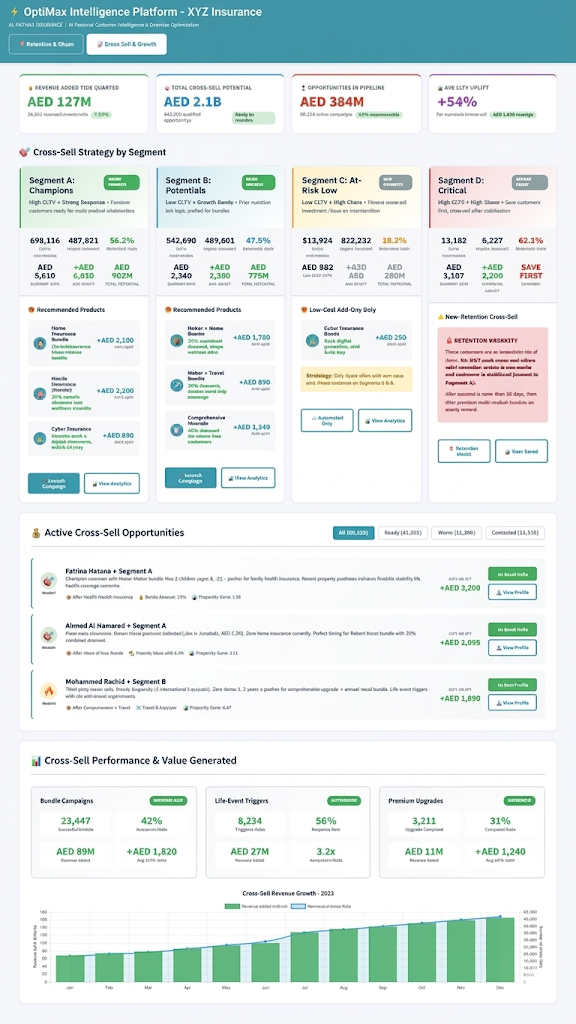
The power of an enterprise framework isn’t theoretical—it’s proven by real-world application. Consider the digital transformation architecture being deployed for an Insurance Firm in Middle East, which serves as a prime example of the OptiMax methodology in action.

By unifying data infrastructure and leveraging custom, interactive digital touchpoints, the platform moves beyond traditional static lead generation. It creates a dynamic, responsive experience that tracks user intent, automates engagement, and provides leadership with clear visibility into conversion funnels and marketing efficiency.
When you replace guesswork with a structured, AI-native infrastructure, marketing ceases to be an opaque financial line item. It becomes a highly scalable, predictable machine for business growth.

5. The Blueprint for Tomorrow
The transition from a cost center to a profitability center requires more than just buying new software; it requires a mindset shift from the top down. As disruptions like GEO reshape consumer and buyer behavior overnight, standing still is the equivalent of moving backward.

Executive leadership must act now to audit their marketing data landscapes, dismantle legacy silos, and implement frameworks built for an AI-first economy. The future belongs to organizations that can turn raw data into immediate, profitable action.
#MarketingStrategy #CMO #MarketingROI #BusinessTransformation #ExecutiveLeadership #Profitability #AIMarketing #GEO (Generative Engine Optimization) #DataLandscape #GenerativeAI #MarTech #PredictiveAnalytics


