
Trend Watch: The Rise of Strategic Human Capital
- Rajesh Koppula

- Jun 4
- 6 min read

In an era where AI can replicate code, summarize contracts, and route logistics overnight, the last truly defensible competitive advantage is how effectively an organization builds, shapes, and adapts its human talent.
The traditional corporate playbook is being rewritten at speed. For decades, "Human Resources" was largely operational — managing payroll, compliance, and hiring pipelines. Today, we are witnessing a paradigm shift of historic scale into the era of Strategic Human Capital. Driven by AI, automation, and shifting demographics, organizations are realizing that technology is no longer the ultimate differentiator. The architecture and adaptability of their human talent is.
The Data Behind AI-Driven Workforce Shifts
The tension between human talent and automation isn't theoretical — it is actively reshaping the global labor market. A look at the numbers over the last three years reveals a stark and accelerating trend:
Key Macro Metrics

2023: Primary Driver: Post-pandemic correction | Signal: Cyclical over-hiring reversal.
2025: Primary Driver: AI infrastructure pivot | Signal: Structural headcount freed for GPU budgets.
2026: Primary Driver: Direct AI substitution | Signal: Substitution era defined by record profits paired with workforce reductions.
The Cost Realignment Signal: In 2026, companies are no longer cutting workers because they are losing money. Many are reporting record profits. Instead, they are replacing cognitive human labor with GenAI agents or redirecting payroll budget directly into GPU clusters and AI infrastructure. The calculus has fundamentally changed.
1. The Skill Revolution: Re-skilling, Up-skilling, and Role Optimization
Organizations are moving away from rigid job descriptions and toward dynamic skills taxonomies. Instead of hiring for a title, leaders are auditing the foundational capabilities their company needs to survive. The World Economic Forum projects that 39% of workers' core skills will change by 2030, with AI and big data topping the fastest-growing skills list.
Three Levers in Play
Up-skilling: Teaching a financial analyst how to use Python or generative AI tools to do their current job 10x faster, or moving a data scientist from model-builder to AI orchestrator.
Re-skilling: Training an assembly line worker to monitor and maintain automated robotics, or converting call center agents into prompt engineers and AI-quality reviewers.
Role Evolution: Shifting human capital out of repetitive data-entry and transactional tasks, and redirecting that budget into strategic, creative, and relationship-driven roles. The "half-life" of a technical skill is now under three years.
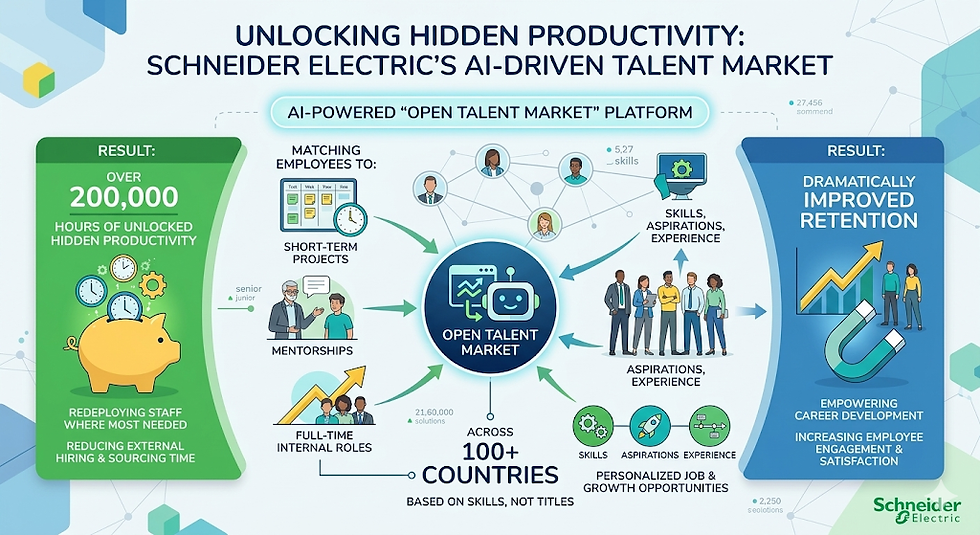
🟢 CASE STUDY: Schneider Electric (France / Global) Schneider launched an AI-driven internal platform — "Open Talent Market" — matching employees with short-term projects, mentorships, and full-time internal roles across 100+ countries based on skills, not titles. The result: over 200,000 hours of unlocked hidden productivity and dramatically improved retention.
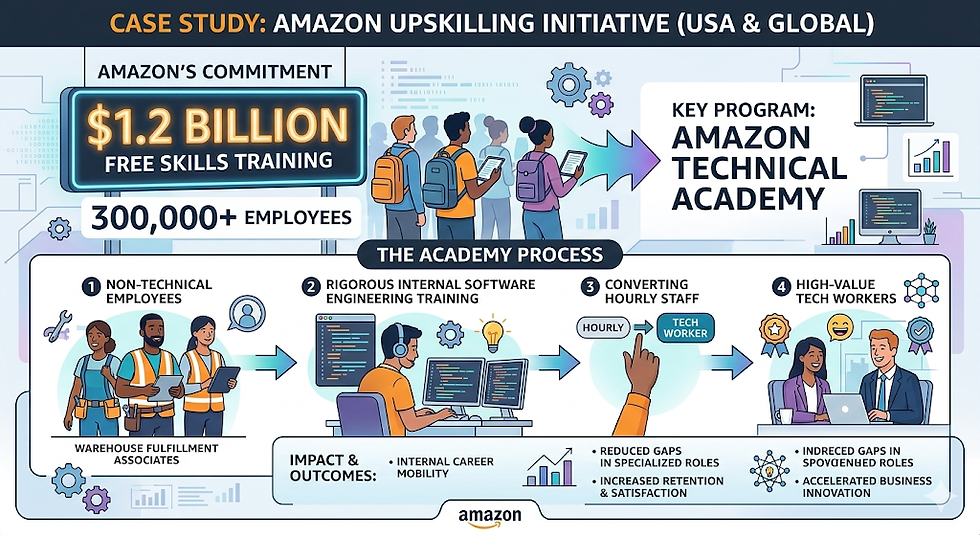
🟢 CASE STUDY: Amazon (USA / Global) Amazon committed $1.2 billion to provide free skills training to over 300,000 employees through its Upskilling initiative. The Amazon Technical Academy takes non-technical employees — including warehouse fulfillment associates — and puts them through rigorous internal software engineering training, converting hourly staff into high-value tech workers.
🟢 CASE STUDY: Salesforce (USA / Global) Through its Trailhead platform, Salesforce is targeting 16 million learners by 2030 — extending the reskilling revolution well beyond its own workforce and into its broader ecosystem of partners and customers. This is human capital strategy deployed as a product strategy.

2. The Great Flattening: Leaner, More Efficient Structures
The days of slow-moving corporate bureaucracy are numbered. Driven by hyper-speed decision-making demands, organizational structures are becoming radically lean. With AI capable of synthesizing data and generating reports instantly, middle management no longer serves as the information relay layer it once did. Organizations are moving toward a "network of teams" — small, autonomous, agile groups formed to solve specific problems and dissolved once the objective is met.
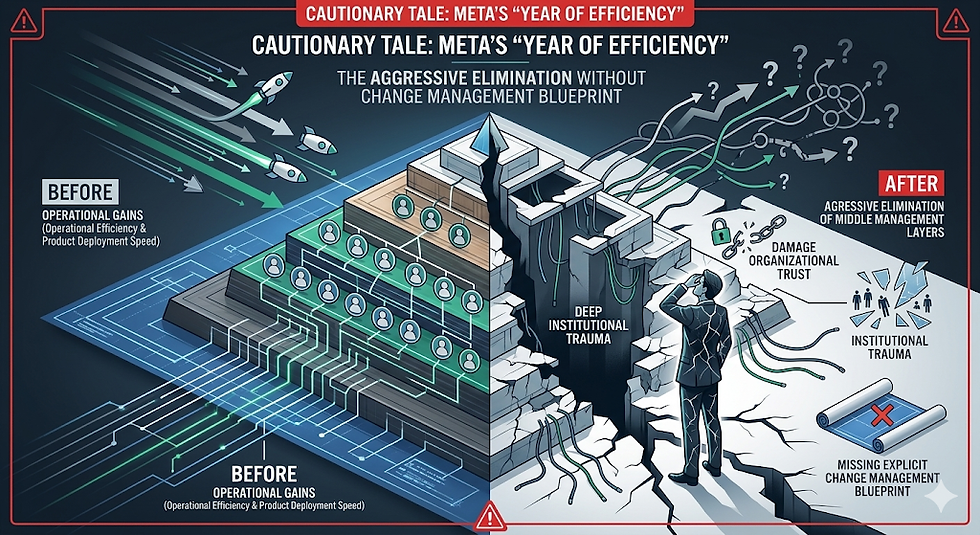
🔴 CAUTIONARY TALE: Meta (USA / Global) The "Year of Efficiency" delivered real operational gains and faster product deployment, but the aggressive elimination of middle management layers without an explicit change management blueprint created deep institutional trauma and damaged organizational trust.
🔴 CAUTIONARY TALE: Klarna (Sweden / Global) Klarna's AI assistant handled the equivalent work of 700 full-time customer service agents in its first month, leading to a massive hiring freeze and workforce reduction. While investors celebrated the capital efficiency gains, this became a stark case study in role elimination occurring without an integrated human safety net.

3. From Pyramids to Diamonds: The Structural Metamorphosis
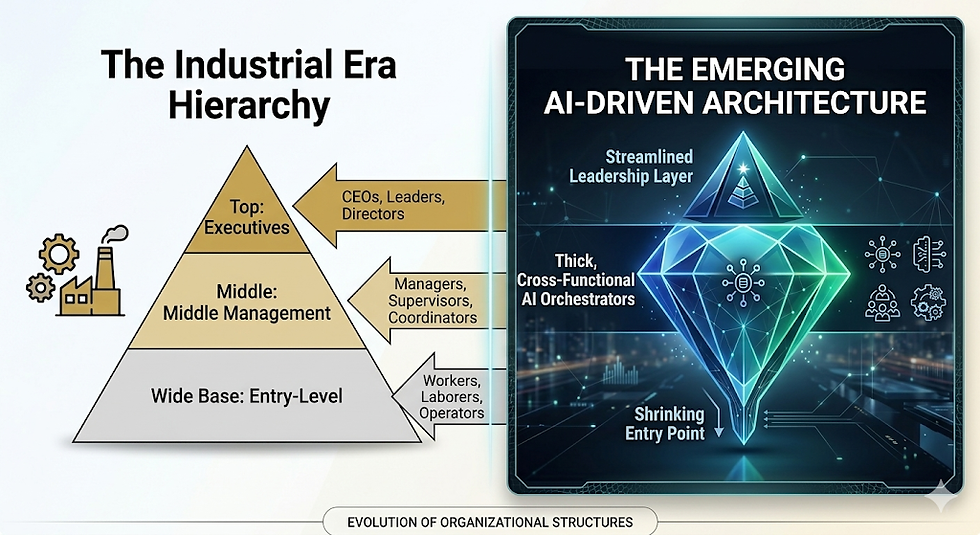
The most disruptive structural change happening across global organizations is the death of the traditional corporate pyramid. The model that most leaders were trained in — a wide base of junior staff tapering upward — is being replaced by something far more nuanced.
The Entry-Level Paradox
AI and automation are absorbing the routine tasks historically given to fresh graduates — basic code drafting, document review, data sorting. This is creating a dangerous bottleneck. If companies simply block the entry point rather than restructuring how humans and AI co-exist, they risk choking off their own future leadership pipeline.
🔴 IBM (USA / Global): Announced plans to pause hiring for approximately 7,800 back-office HR and administrative roles deemed replaceable by AI, crystallizing this exact bottleneck.
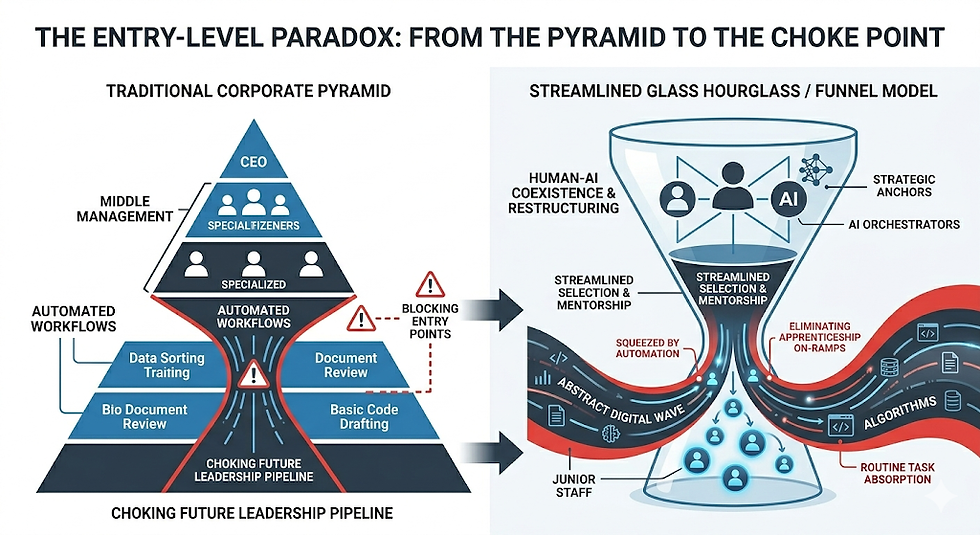
🟡 Wipro & IT Services (India / Global): Undergoing a structural reinvention in real time. Because GenAI handles massive chunks of research and coding, early-career talent is being immediately trained as "AI Orchestrators" rather than raw analytical labor.
The Architectural CEO
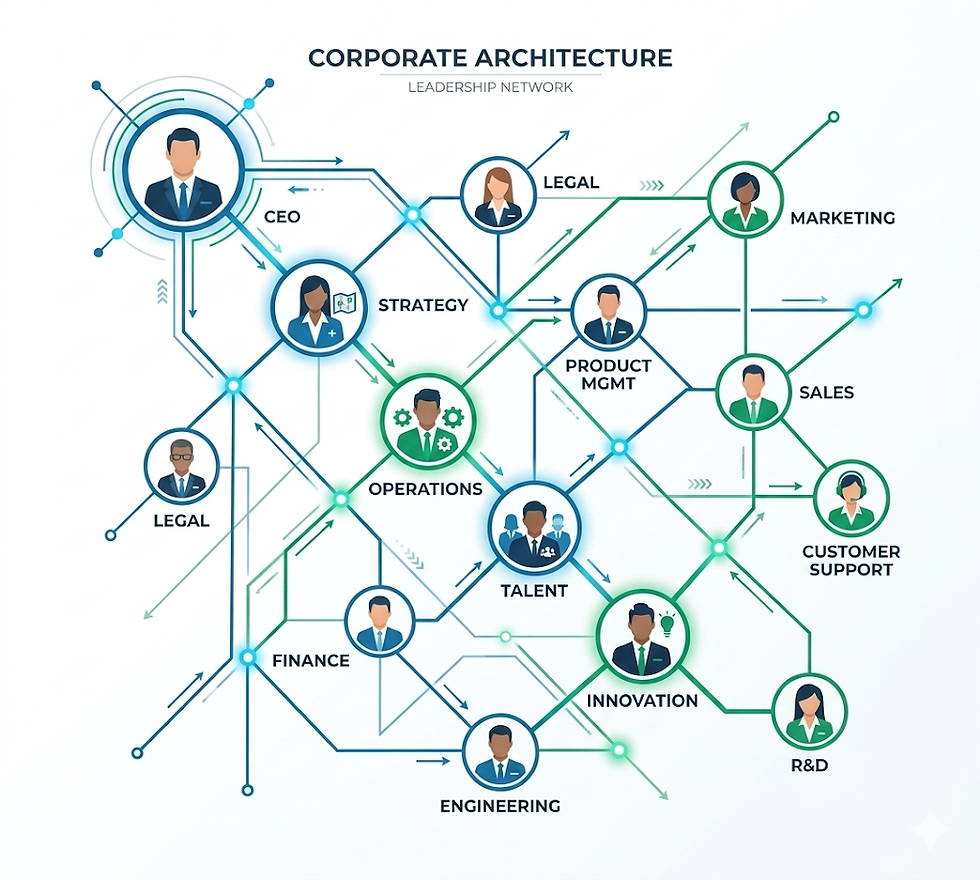
As organizations evolve from top-down hierarchies into complex, interconnected systems, executives must make a fundamental shift in how they lead. The Architectural CEO doesn't dictate everyday tasks — they design the ecosystem. They align technology infrastructure with human talent, remove institutional roadblocks, and ensure cross-functional teams can collaborate without friction. This is less about top-down authority, and more about systems design.
4. Doing More With Less: The New Productivity Frontier
We are entering an era of unprecedented capability compression. The integration of advanced AI tools means that small, highly resourced teams can compete with legacy giants. A team of five product designers equipped with generative tools can now brainstorm, prototype, and iterate at a speed that used to require a department of fifty. Capital efficiency is skyrocketing, and the definition of "market scale" is being decoupled from headcount.
AI Market Scale: Growing at ~37% annually.
The ROI Alignment Gap: Organizations realize a 1.6× lower return on AI adoption if workers are not explicitly reskilled alongside the tools.
Skill Longevity: The half-life of a technical corporate skill is now under 3 years, down from 5–7 years a decade ago.
5. Org Psychology: Managing Friction and Resistance
Any transformation of this scale triggers profound psychological resistance. Fear of obsolescence, change fatigue, and friction between legacy mentalities and modern workflows can paralyze an organization. Deloitte's Global Human Capital Trends report delivers a sobering data point: while 85% of leaders say building adaptability at speed is critical, only 7% believe they're actually leading effectively on that front.
The New Performance Standard
Performance is no longer a static measurement of past output. In the AI era, it is a continuous reflection of an employee's velocity of learning. Organizations must redesign their incentive structures accordingly — rewarding agility, cross-functional mobility, and skill acquisition, not just output volume or hours logged.
🟢 Unilever (UK / Global): Committed to reskilling its entire 148,000-person workforce with a focus on digital literacy and agile workflows. They pioneered flexible fractional contracts to retain older workers' deep institutional knowledge while adapting operational roles to automation.
🔴 Samsung (South Korea / Global): Facing intense AI chip competition, Samsung mandated a 6-day executive workweek to instill an organizational crisis mindset. The move highlighted deep friction between legacy input-driven management and the output-and-agility model demanded by modern talent, triggering widespread burnout. Urgency without sustainability is not a strategy.
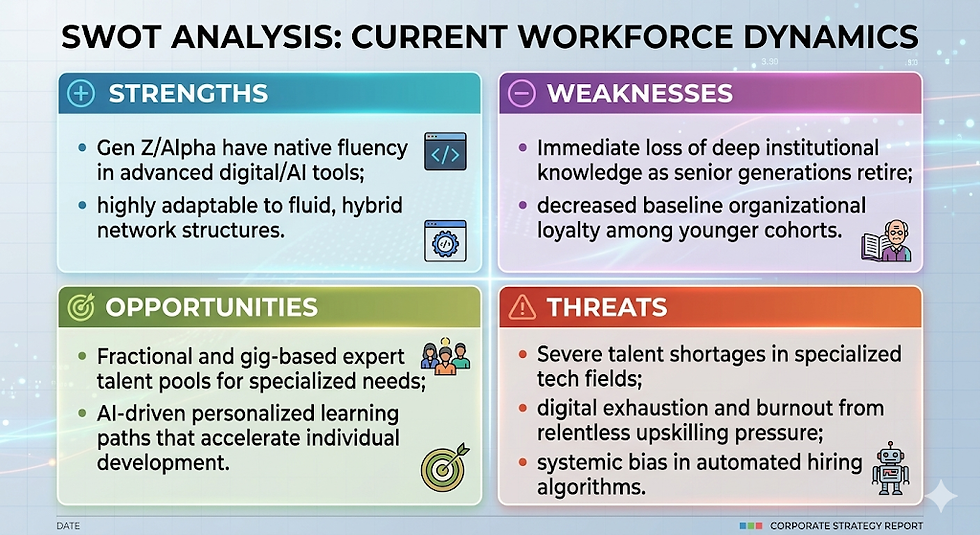
6. Demographic Dynamics: A Brief SWOT Analysis
7. The Blueprint: Navigation Playbook
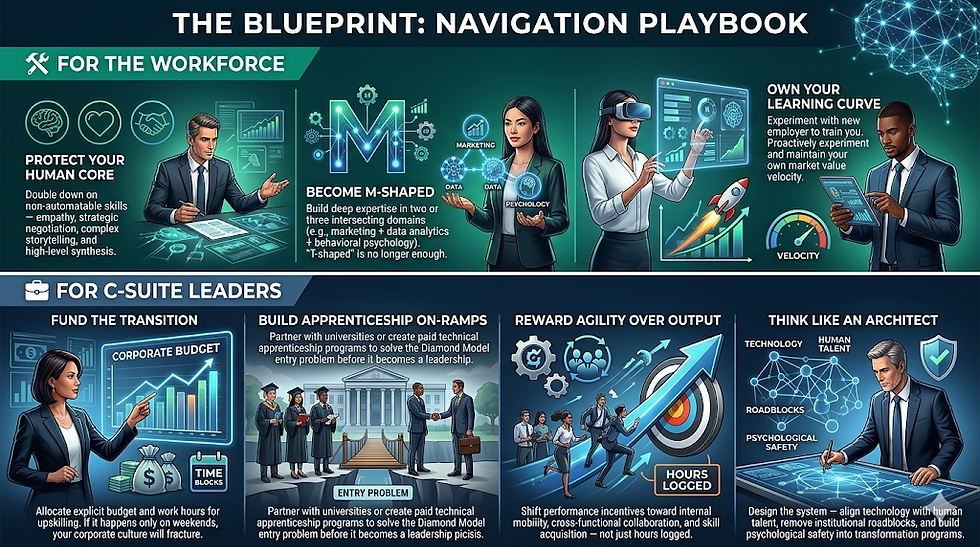
🛠️ For the Workforce
Protect Your Human Core: Double down on non-automatable skills — empathy, strategic negotiation, complex storytelling, and high-level synthesis.
Become M-Shaped: Build deep expertise in two or three intersecting domains (e.g., marketing + data analytics + behavioral psychology). "T-shaped" is no longer enough.
Own Your Learning Curve: Don't wait for your employer to train you. Proactively experiment with new tools and maintain your own market value velocity.
💼 For C-Suite Leaders
Fund the Transition: Allocate explicit budget and work hours for upskilling. If it happens only on weekends, your corporate culture will fracture.
Build Apprenticeship On-Ramps: Partner with universities or create paid technical apprenticeship programs to solve the Diamond Model entry problem before it becomes a leadership pipeline crisis.
Reward Agility Over Output: Shift performance incentives toward internal mobility, cross-functional collaboration, and skill acquisition — not just hours logged.
Think Like an Architect: Design the system — align technology with human talent, remove institutional roadblocks, and build psychological safety into transformation programs.
Conclusion: The Last True Strategic Advantage
"Technology can be copied, licensed, or reverse-engineered overnight. Human ingenuity — and the organizational systems that amplify it — cannot."
In an era of abundant AI, the organizations that win will not be those with the most compute. They will be those with the most adaptive, strategically deployed, and well-led human capital. Hardware is a commodity. Software is a subscription. Your people — how fast they learn, how effectively they collaborate, and how dynamically your leadership architects their potential — are the one thing competitors cannot simply replicate.
The companies that realize this, adjust their structures, invest in their people through the transition, and lead with both technological ambition and human empathy will define the next era of competitive advantage.


